Hemaferese; folder Matchis Engels
Introduction
You have recently undergone a medical assessment for a stem cell donation. Through Matchis, you have received all the necessary information about the stem cell donation process. During your visit to the apheresis unit, your veins were assessed to determine whether they are suitable for the collection procedure. You were also given a tour of the apheresis department and informed about when you will be contacted regarding the start of the growth factor treatment. The date is enclosed with this leaflet on a separate document.
Below is a summary of the information.
Once the collection date has been confirmed and you have been approved as a stem cell donor, the following steps will take place. (In some cases, you may not yet have received official approval, but you can already begin preparing for the next steps.)
The hospital pharmacy of the LUMC will arrange delivery of the filgrastim (growth factors). You will receive an email containing a link to schedule a delivery appointment for the filgrastim. In some cases, filgrastim may also be delivered in the evening. The day before delivery, you will receive a live tracking link with the expected delivery times. The courier can only hand over the medication to a person who is present at the delivery address and is at least 18 years old.
Before you start using filgrastim, you will receive a phone call from an apheresis nurse (usually 1–2 days in advance). Following this call, you will receive an email from the Apheresis Department containing the mobilization schedule (indicating the day you should start and the dosage you should use), and, if applicable, a link to the instructional video: “Filgrastim Administration at LUMC.”
The video can be viewed via: https://youtu.be/nH31ZPPQwkg
Or by scanning the QR code:

This explains step by Step how to use the Filgrastim
Stem Cell Donation
Peripheral Stem Cells
Stem cells are normally found only in the bone marrow and, to a very small extent, in the blood. By administering growth factors to a donor, the bone marrow is strongly stimulated to temporarily produce extra stem cells. This increase allows stem cells to enter the bloodstream. The growth factor injections are given subcutaneously (under the skin) for five days.
Side Effects
During the days when growth factors are administered, most donors experience some bone, muscle, and headache, and sometimes flu-like symptoms, occasionally with a mild fever. A temperature up to 38.5°C is considered acceptable. You may use paracetamol to relieve these symptoms; other painkillers should only be taken after consulting the Matchis physician, the transfusion medicine physician, or the LUMC Apheresis Department. These side effects mostly disappear within 24 hours after the last growth factor injection. Within 48 hours, all symptoms should be gone.
Serious side effects are very rare. If you experience pain in the left side, contact a physician immediately! If you have any symptoms, doubts, or concerns, you can call the Apheresis Department, where you will be connected to the on-duty transfusion medicine physician if necessary.
Day of Collection
On the fifth day after starting the growth factors, stem cells are collected at the Apheresis Department, C-11-P, Room 44, or Route 265. Please arrive by 8:15 AM. If you are already in the hospital, come directly to the apheresis department. Once the machine is ready, the stem cell collection will begin.
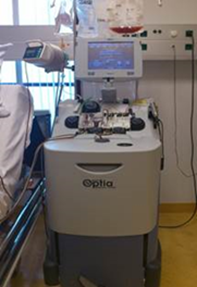
During an apheresis, a steel needle/infusion needle is inserted into one arm, and an infusion needle is placed in the other arm. In some cases, two infusion needles may be used.
The blood flows through a sterile tubing system into an apheresis machine. In this machine, the different blood cells are separated, and the stem cells are collected. The remaining blood components are returned to the donor through the infusion needle.
A stem cell apheresis can last up to eight hours, though it typically takes four to six hours. Sometimes, the procedure must be repeated the following day if the target number of stem cells is not reached on the first day. Because needles are placed in both arms, your mobility will be limited during the procedure. The collected stem cells are administered to the patient either the same day or the following day.
Advice for the First Administration:
- Make sure someone is with you during the first administration of the growth factors.
- Take it easy during the first hour after the injection.
- Do not participate in traffic (drive, cycle, etc.) during the first hour after the injection.
Other Recommendations:
- Use only paracetamol for pain relief. Contact a physician if paracetamol is insufficient. Do not use ibuprofen, diclofenac, or other NSAIDs.
- Wear or bring comfortable clothing (e.g., sweatpants, a cardigan/jacket).
- Bring entertainment such as a tablet, laptop, game, book, or magazine.
- Someone may stay with you all day.
- You may not go home alone at the end of the day. Arrange transport or have a taxi organized through Matchis (please allow for waiting time).
- Coffee, tea, soft drinks, and a sandwich meal are provided (bring your own items if you have specific dietary requirements).
Contact Information:
- The Apheresis Department is reachable on weekdays from 8:30 AM to 5:00 PM. You will receive a wristband; at any time, you may press “2” for urgent matters.
- Outside office hours and on holidays, contact the Hematology Nursing Department at 071-5263060. The nurse will ask for your date of birth and LUMC number (found on the card you received at the Apheresis Department with your start and collection dates). You will then be called back by the on-duty physician.
- The day after the stem cell collection, you will receive a call from the apheresis nurse to check on how you are feeling.
Important telephone numbers:
Matchis Foundation: | 071-5685300 |
Departement of Aferesis: | 071-5263810 |
Department Hematoly | 071-5263060 |
General number UMC: | 071-5269111 |