How a mouse from Leiden is advancing cardiovascular research worldwide
&width=710&height=710)
The patient who started it all
In the early 1980s, Leiden researcher Louis Havekes described a 41-year-old man with highly elevated levels of cholesterol and other lipids in his blood. He also presented with prominent lipid deposits in the skin. The clinical picture pointed to a profound disturbance in lipid metabolism, but the underlying cause remained unclear.
The symptoms were eventually traced to an impaired ApoE function. ApoE is a protein that normally facilitates the clearance of cholesterol and triglyceride-rich lipoproteins from the bloodstream by the liver. In this patient, that process was severely impaired, causing these particles to accumulate in the circulation. “When it became apparent that his mother and four siblings also had elevated cholesterol levels and similar clinical features, it was clear that this was an inherited disorder,” professor Ko Willems van Dijk explains.
In 1986, this inherited ApoE variant was designated ApoE*3-Leiden, named after the city in which it was first identified.
Ancestors from the 17th century
In the years that followed, the researchers identified additional individuals carrying ApoE*3-Leiden. At first glance, these individuals appeared unrelated, but genealogical analyses revealed a remarkable link: all could be traced back to the same ancestors who lived in the seventeenth century.
ApoE*3-Leiden was later also identified in a larger family study. Together, these investigations demonstrated that ApoE*3-Leiden is an inherited genetic trait that has been passed down through Dutch families for centuries.
From patient to animal model
The next step was to determine whether ApoE*3-Leiden was indeed responsible for the elevated cholesterol and lipid levels observed in these patients. However, the full biological consequences of such inherited genetic alteration could not be studied directly in humans.
Together with Leiden researcher Rune Frants, Louis Havekes therefore set out to develop an animal model. Their objective was to introduce the human ApoE*3-Leiden variant into the mouse genome, allowing them to investigate how this genetic alteration affects physiological processes throughout the body.
Developing such a model proved far from straightforward. “Of the first 36 mice, only six successfully incorporated the human ApoE*3-Leiden variant into their DNA. Of those six, only three transmitted the variant to their offspring. Ultimately, all ApoE*3-Leiden mice used today are descended from one of those three founder animals,” says Willems van Dijk.
A mouse model of atherosclerosis
The newly developed ApoE*3-Leiden mice exhibited elevated plasma cholesterol and triglyceride levels when fed a specialized diet, exactly as anticipated. However, the researchers made an unexpected discovery: the mice also developed atherosclerosis. This disease is characterized by the accumulation of lipids, cholesterol, and inflammatory cells within the arterial wall, leading to progressive narrowing of the arteries and, in some cases, complete vessel occlusion. As a result, the risk of cardiovascular events such as myocardial infarction and stroke increases.
“Wild-type mice rarely develop atherosclerosis spontaneously. That is precisely why this finding was so important,” explains Willems van Dijk. “At the same time, atherosclerosis is difficult to study in humans. Lifestyle, diet, age, and alteration predisposition all contribute to disease development, yet these factors vary considerably from one individual to another. Moreover, it is impossible to observe the initiation and progression of atherosclerosis in humans over extended periods under controlled conditions. The ApoE*3-Leiden mouse, together with other models developed around the same time, provided researchers with an unprecedented opportunity to study the disease in detail in a living organism.”
The ApoE*3-Leiden mouse also enabled researchers to evaluate potential therapeutic interventions. Like humans, these mice responded to virtually all major classes of cholesterol-lowering drugs including statins. “A model that develops disease is interesting,” says Professor Patrick Rensen. “But a model that responds to the same drugs as patients is truly valuable.”
Adding CETP: version 2.0 of the model
Although the ApoE*3-Leiden mouse represented a major advance, an important difference between humans and mice remained. Rensen: “Humans express CETP, a protein that plays a key role in cholesterol transport in the bloodstream. Conventional mice do not naturally produce this protein.” To address this limitation, researchers introduced the human CETP gene in 2006. This led to the development of the ApoE*3-Leiden.CETP mouse, a model that more closely resembles human lipid metabolism.
The addition proved highly successful. The new ApoE*3-Leiden.CETP mice developed up to seven times more atherosclerosis than the original ApoE*3-Leiden mice.
The text will continue after the information box.
How the model works
To induce atherosclerosis, ApoE*3-Leiden.CETP mice are typically fed a diet containing a small amount of added cholesterol for 12 to 16 weeks. The duration of dietary intervention depends on the composition of the diet and the desired stage of atherosclerotic lesion development.
In prevention studies, researchers investigate whether a therapeutic intervention can prevent or delay the development of atherosclerosis. Mice therefore receive both the cholesterol-containing diet and the treatment from the start of the experiment. However, patients often remain asymptomatic until atherosclerosis is already well established. To mimic this clinical situation, regression studies investigate whether treatment can halt, stabilize, or reduce existing atherosclerotic lesions. In these studies, mice are first maintained on the cholesterol-containing diet until the disease has developed, after which treatment is initiated.
Cardiovascular research using the ApoE*3-Leiden.CETP mouse model (Click on the picture to enlarge)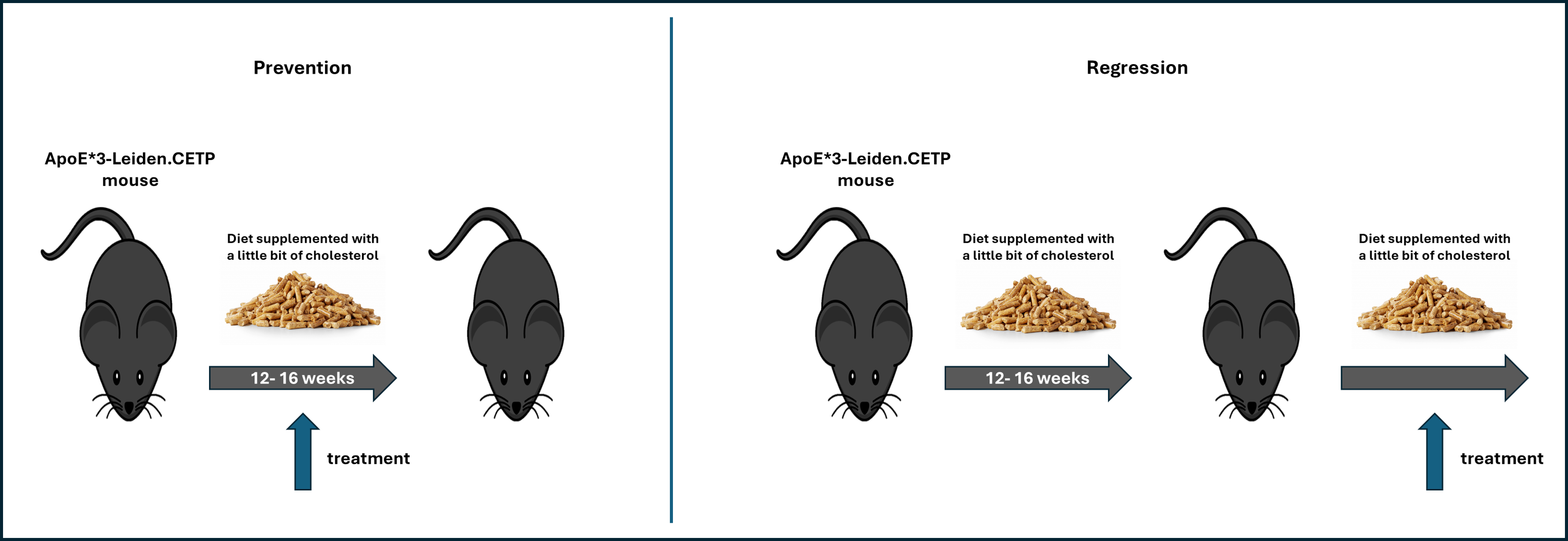
In both study designs, animals are randomly assigned to two groups. One group receives the experimental treatment with an active compound, while the control group receives an identical treatment without the compound. Differences between the groups allow researchers to determine whether the intervention affects disease development or progression.
Insights gained from the mouse model
The ApoE*3-Leiden.CETP mouse also provided valuable insights into novel therapeutic strategies for cardiovascular disease. Previous studies had consistently demonstrated an inverse association between HDL-cholesterol levels and cardiovascular risk, raising the question whether pharmacologically increasing HDL levels could translate into a reduction in cardiovascular risk.
In 2006, a large clinical trial involving more than 15,000 individuals at increased risk of cardiovascular disease was launched to evaluate torcetrapib, one of the first HDL-raising drugs. At the same time, researchers in Leiden investigated the effects of the same compound in the ApoE*3-Leiden.CETP mouse.
Although torcetrapib increased HDL-cholesterol levels in both humans and mice, the researchers also observed an unfavorable effect in the mice: increased accumulation of inflammatory cells within the arterial wall, accompanied by an increase in the blood pressure-increasing hormone aldosterone. These inflammatory cells can make the atherosclerotic lesions unstable and as a result increase the risk of infarction or stroke.
Shortly thereafter, the clinical trial in humans was terminated prematurely because mortality was higher among treated individuals compared to the control group. “If this compound had first been tested in our mouse model, the human trial might have been reconsidered,” says Rensen.
“An association does not automatically imply causation,” Willems van Dijk emphasizes. “It is not only the concentration of HDL that matters, but also how HDL functions within the body. Our model helped researchers understand why one of the first therapies designed to raise HDL levels failed to deliver the expected cardiovascular benefit, despite successfully increasing HDL-cholesterol levels.”
All models are wrong
Not everyone was immediately convinced of the value of mouse models for cardiovascular research.
“Criticism was common at scientific meetings,” recalls Willems van Dijk. “A prominent researcher at one time had said: all models are wrong, some are useful.” He understands that skepticism. Mice and humans differ in many important respects. “But that is precisely the challenge. The better we understand those differences, the better we understand the underlying biology,” he says.
Over the past decades, the model has undergone a series of improvements. First through the development of ApoE*3-Leiden and later through the introduction of CETP. Researchers also adjusted the animals’ housing conditions and diets to better mimic human metabolism.
“Continuous refinement is precisely why the ApoE*3-Leiden.CETP mouse remains relevant after all these years,” says Rensen. “The model has enabled us to gain deeper insight into the mechanisms that drive cardiovascular disease and has provided researchers with a powerful platform for the development and evaluation of new therapeutic strategies.”
Are there alternatives?
This type of research raises an important question: are animal models truly necessary? At LUMC, animal studies are only conducted when no suitable alternative is available.
“Research using cell cultures, organoids, and other laboratory models can provide valuable insights,” says Rensen. “However, these approaches typically focus on only a small part of a much larger biological system. “Atherosclerosis involves the interplay of many organs and biological processes. Organs such as the liver, intestine, adipose tissue, skeletal muscle, and brain continuously interact with the immune system, hormones, nerves, blood vessels, and the body's cholesterol metabolism. To understand this interplay and see the full picture, animal studies remain necessary.”
The use of animal models is guided by the principles of the 3Rs: Replacement, Reduction, and Refinement. Researchers must demonstrate that no suitable non-animal alternative exists, that the smallest possible number of animals is used, and that experimental procedures are designed to minimize discomfort and maximize animal welfare.
From a single patient to a globally adopted research model
Originally, the ApoE*3-Leiden.CETP mouse was developed to improve our understanding of cardiovascular disease. Over time, its applications expanded far beyond atherosclerosis research. Today, the model is widely used in studies of obesity, type 2 diabetes, metabolic dysfunction-associated steatotic liver disease (MASLD), and even sepsis. It has also enabled researchers to investigate the effects of novel therapeutics, environmental contaminants such as PFAS, and lifestyle-related factors including diet, circadian rhythms, and the gut microbiome.
The text will continue after the information box.
The model is now employed worldwide in collaborations involving academic institutions, research organizations, large pharmaceutical companies, and biotechnology start-ups. Studies using the ApoE*3-Leiden.CETP mouse have generated hundreds of scientific publications and contributed to the development of numerous patents, drug candidates, and therapeutic innovations. “When we started, we could never have imagined how broadly applicable this model would become,” says Willems van Dijk.
In recognition of its exceptional contribution to biomedical research, the ApoE*3-Leiden mouse was even awarded a place in the Boerhaave Museum in Leiden. It is a fitting tribute to a mouse model that originated from the investigation of a rare inherited disorder and evolved into a globally used platform for translational research.
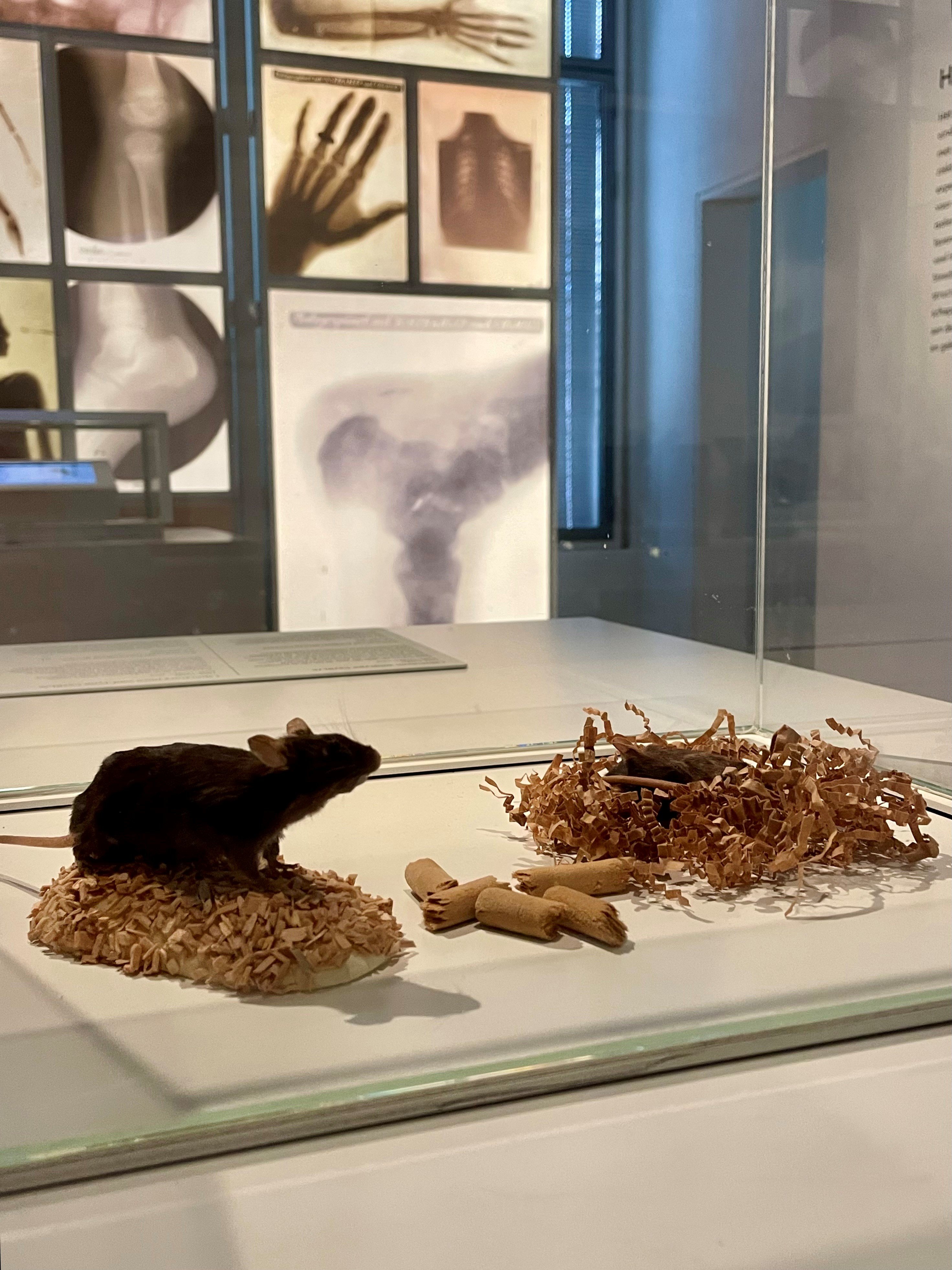
Picture: ApoE*3-Leiden mouse at Boerhaave Museum
Source: Patrick Rensen in collaboration with Boerhaave Museum
More information
Additional information about the ApoE*3-Leiden.CETP mouse model can be found on the websites of the Rensen Laboratory and TNO.
For readers interested in the broader field, a comprehensive scientific review of the various mouse models used in atherosclerosis research can be found here. This review discusses the strengths, limitations, and applications of the most widely used models for studying the development and treatment of atherosclerosis.
This research is part of the Innovation Themes Cardio-Vascular and Prevention&Lifestyle.

&width=710&height=710)
&width=710&height=710)
&width=710&height=710)