Tiong Ang
Neurodiversity LUMC / LUMC Pride
In Auto-Portrait, Tiong Ang paints himself lifting a mask, as if the portrait does not reveal who he is, but rather the parts of himself he dares to show, or who he thinks he is expected to be. We recognize that feeling.
For many people within the Pride and Neurodiversity networks, that mask is not an artistic device, but an everyday reality. You put it on as soon as you step outside the door: at work, in the consulting room, on the street. Not because you do not want to be yourself, but because it can feel as though the world around you does not automatically provides space for who you are.
…In Auto-Portrait, Tiong Ang paints himself lifting a mask, as if the portrait does not reveal who he is, but rather the parts of himself he dares to show, or who he thinks he is expected to be. We recognize that feeling.
For many people within the Pride and Neurodiversity networks, that mask is not an artistic device, but an everyday reality. You put it on as soon as you step outside the door: at work, in the consulting room, on the street. Not because you do not want to be yourself, but because it can feel as though the world around you does not automatically provides space for who you are.
What makes this work so powerful to us is that the mask is visibly loose. It is being lifted, questioned. That is exactly what we want: an LUMC where that mask can be left hanging by the door. Having to present yourself as someone other than who you are in order to belong should simply no longer be necessary.
For many people within the Pride and Neurodiversity networks, that mask is not an artistic device, but an everyday reality. What makes this work so powerful to us is that the mask is visibly loose. It is being lifted, questioned. That is exactly what we want: an LUMC where that mask can be left hanging by the door. Having to present yourself as someone other than who you are in order to belong should simply no longer be necessary.
About the work
Tiong Ang (1961) was born in Indonesia into a Chinese family. During the political unrest in the sixties, the family fled to the Netherlands. Slowly his memory of Asia faded. Nevertheless, Ang's ethnicity is deeply rooted and determines his being, his thinking, his art and his identity.
Ang deals with different forms of human presence and representation in his work. In this work, he plays with the idea that a portrait is a mask rather than a representation.
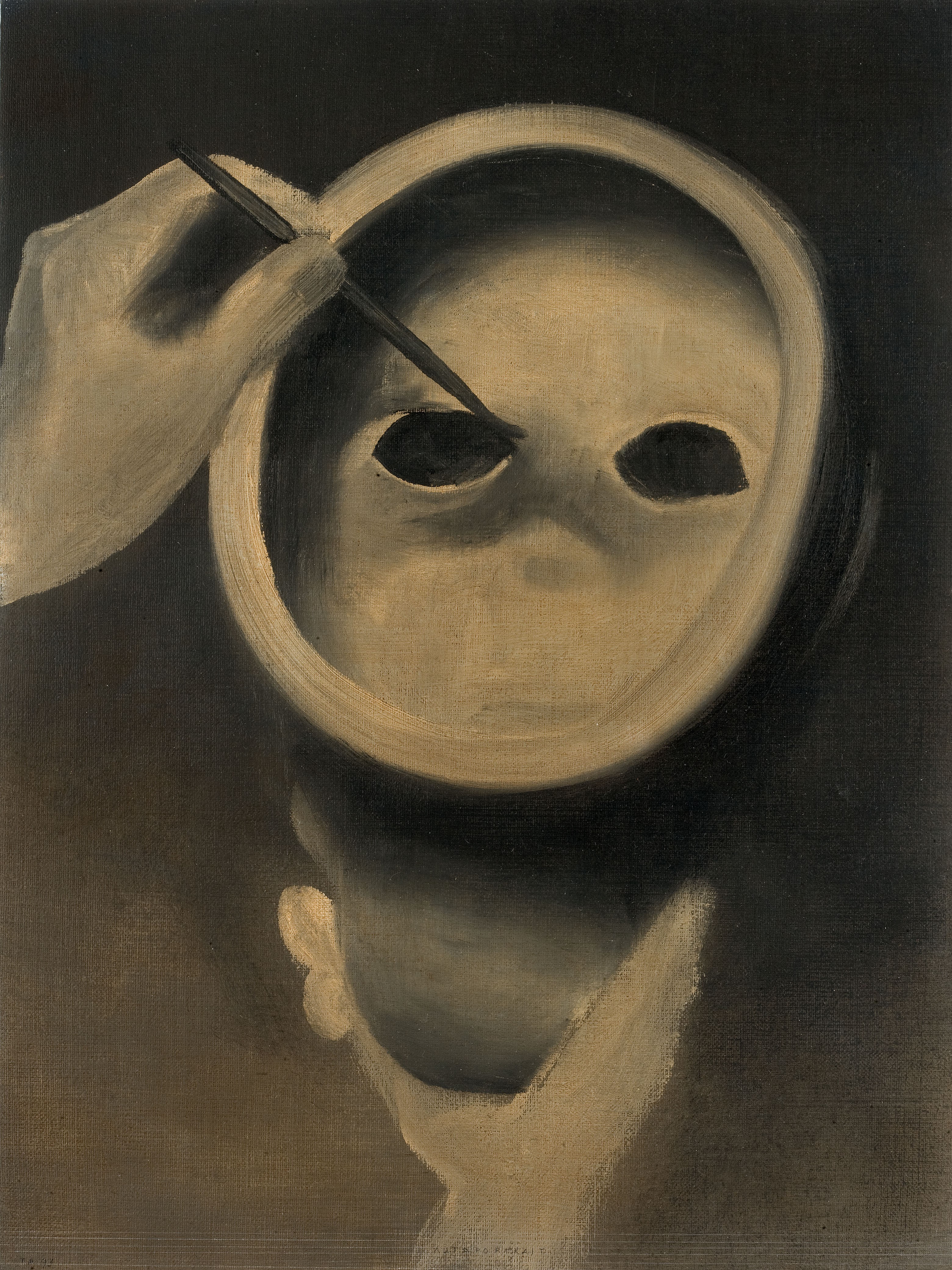
Alkyd on canvas, 54 x 43.5 cm, 1993