At the Willem-Alexander Children's Hospital, together with the parents, we provide the best care to children with lung diseas

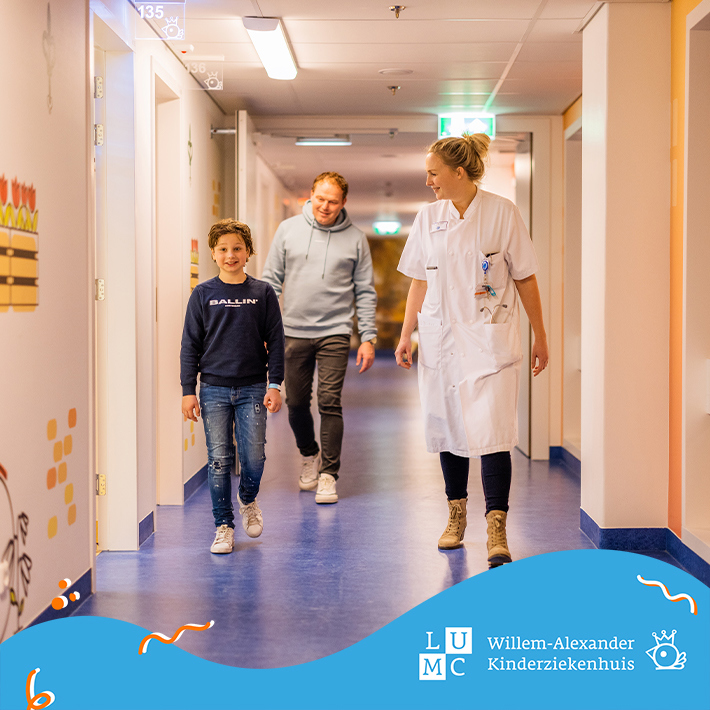
At the Willem-Alexander Children's Hospital, together with the parents, we provide the best care to children with lung disease. Our pediatric pulmonologists specialize in complex lung diseases, such as difficult-to-treat asthma, congenital lung diseases, or infections. We also treat children who come to the Willem-Alexander Children's Hospital with another illness, but where there may also be an issue with the lungs. For example, children undergoing heart surgery or children receiving a stem cell transplant.
…At the Willem-Alexander Children's Hospital, together with the parents, we provide the best care to children with lung disease. Our pediatric pulmonologists specialize in complex lung diseases, such as difficult-to-treat asthma, congenital lung diseases, or infections. We also treat children who come to the Willem-Alexander Children's Hospital with another illness, but where there may also be an issue with the lungs. For example, children undergoing heart surgery or children receiving a stem cell transplant.
Our pediatric respiratory nurse supports all consultations. Parents and children can easily contact the respiratory nurse if necessary.
What we do
Asthma
is a common lung disease in children. At the Willem-Alexander Children's Hospital, we treat children with severe asthma. These are children who have been admitted to the intensive care unit with an asthma attack, or children whose asthma is not well controlled with standard treatment.
Improvement
In children with severe asthma, we carefully examine how we can ensure improvement. For example:
- Are there risk factors and triggers for asthma? Such as animals, smoking, or mold?
- Is a change in medication necessary?
- Is the inhalation technique for puff medication correct?
Instructions for an asthma attack
We provide parents with instructions on what to do if the asthma is not well controlled. We also let them know when it is advisable to get in touch. Parents and child can participate in Luchtbrug, an online program to monitor asthma at home.
Underlying causes
Sometimes, even with standard medication and avoiding risk factors, asthma remains unstable. In such cases, we look for other underlying physical causes. We also assess whether different medication can be prescribed.

"We offer the best care to children with a lung disease".
Treatment
Additional tests
Sometimes additional tests are needed to determine if there is a lung disease and if it has been treated properly. Many tests can be performed on an outpatient basis. Sometimes a day admission is necessary. Examples of tests we perform are:
Lung function (spirometry)
The lung function technician at the LUMC specializes in lung function testing (spirometry) in young children. This is usually possible from the age of 4.
Bronchoscopy (endoscopic examination):
A bronchoscopy is an endoscopic examination of the lungs. Under general anesthesia, a small camera is used to look inside the lungs. We can then see if the lungs appear normal. We can also test for any bacteria or inflammation. We will explain exactly what we are going to do beforehand. Pedagogical staff will accompany the child.
Chest X-ray or lung scan
Sometimes a chest X-ray or a CT scan of the lungs is taken. This is done in the radiology department .
Appointment and admission
Outpatient clinic
Our pediatric respiratory nurse usually sees the children first and asks how they are doing and if they are managing with the medication. The pediatric respiratory nurse also checks if the child is growing well. Afterwards, the pediatric pulmonologist examines the child. The lungs are listened to carefully. If a spirometry test is necessary, we try to schedule it on the same day.
…Outpatient clinic
Our pediatric respiratory nurse usually sees the children first and asks how they are doing and if they are managing with the medication. The pediatric respiratory nurse also checks if the child is growing well. Afterwards, the pediatric pulmonologist examines the child. The lungs are listened to carefully. If a spirometry test is necessary, we try to schedule it on the same day.
Day admission
If a bronchoscopy is necessary, it is performed via a short day admission. The child can then almost always go home the same day.
Intake
Sometimes admission is necessary, for example if the asthma is uncontrolled. This takes place at Bos or Strand. There is a ward doctor on the department, and the pediatric pulmonologist usually visits as well.
Our team
Our team consists of 2 pediatric pulmonologists and 1 pediatric respiratory nurse.
We work closely with the pulmonary function department (for the breath tests) and the endoscopy department (for the bronchoscopies).