Services
Closely integrated with the LUMC Preclinical Imaging Facility, the PDC hosts state-of-the-art facilities for the preclinical evaluation of in vivo brain neurophysiology (in anesthetized and freely behaving mice) and muscle physiology (and neuromuscular performance). These platforms are embedded within the LUMC Research Theme Neuroscience and enable a uniquely powerful combination of in vivo outcome measures that are complemented by general behavioral and advanced imaging platforms. Together, these infrastructures support translational research aimed at understanding disease mechanisms as well as developing and testing innovative therapies for (non)-genetic neurological and neuromuscular disorders.
…Closely integrated with the LUMC Preclinical Imaging Facility, the PDC hosts state-of-the-art facilities for the preclinical evaluation of in vivo brain neurophysiology (in anesthetized and freely behaving mice) and muscle physiology (and neuromuscular performance). These platforms are embedded within the LUMC Research Theme Neuroscience and enable a uniquely powerful combination of in vivo outcome measures that are complemented by general behavioral and advanced imaging platforms. Together, these infrastructures support translational research aimed at understanding disease mechanisms as well as developing and testing innovative therapies for (non)-genetic neurological and neuromuscular disorders.
These research activities are organized across biological themes and span multiple departments, reflecting the collaborative nature of the Research Theme Neuroscience. The platforms are run by principal investigators Prof. dr. Arn van den Maagdenberg & Dr. Else Tolner (brain physiology; Human Genetics & Neurology), Prof. dr. Annemieke Aartsma-Rus & Dr. Maaike van Putten (muscle physiology; Human Genetics) and Prof. dr. Louise van der Weerd (advanced imaging; Human Genetics & Radiology). Many of the genetic mouse lines used on the platforms are in-house generated by the Transgenic Facility Leiden.
&width=710&height=710)
&width=710&height=710)
Husbandry and care
The welfare of the animals is a joint responsibility of the researchers and the PDC. The PDC provides daily care in the form of appropriate housing (IVC), food and water, and daily welfare checks of the animals. The researchers have the responsibility to provide care to their animals while in procedures.
All animal work is done with SPF animals, a variety of autoclaves and hydrogen peroxide (H2O2) equipment enable this, next to our IVC housing, isocages and others. In order to maintain our current SPF status, entrance level is very strict for biological material and the animals are checked according to quarterly and annual profiles according to FELASA recommendations 2014.
…The welfare of the animals is a joint responsibility of the researchers and the PDC. The PDC provides daily care in the form of appropriate housing (IVC), food and water, and daily welfare checks of the animals. The researchers have the responsibility to provide care to their animals while in procedures.
All animal work is done with SPF animals, a variety of autoclaves and hydrogen peroxide (H2O2) equipment enable this, next to our IVC housing, isocages and others. In order to maintain our current SPF status, entrance level is very strict for biological material and the animals are checked according to quarterly and annual profiles according to FELASA recommendations 2014.
In principle, no commercially available strains/lines of rodents are bred. The breeding program is, therefore, limited to unique genetically altered lines. The breeding colony is located in a full SPF barrier breeding unit with all mice in IVC cages.
Dedicated animal care staff executes the breeding based on regular (intermittent) breeding protocols to reduce excess breeding. Where necessary breeding protocols are guided by the researchers.
Education and training
Four times a year (Oct, Dec, Mar, June), the Laboratory Animal Science course is run by the PDC and external tutors. The course is acknowledged by the Dutch government, as well as accredited by FELASA.
By law, individuals performing animal experiments must be knowledgeable and competent.
Therefore, the PDC offers practical/vocational training in the context of continuing professional development (CPD).
Generation of genetically altered animals
The Transgenesis Facility Leiden (TFL) provides full tailor-made transgenesis services. The TFL-staff takes your requests and generates your unique GA-line using state-of-the-art technologies
The TFL provides the following services for its projects:
- Together with the researchers translate the research question into the best possible in vitro mouse ES or in vivo model
- Design of the model
- Identification of the best technology for the project
- Design and cloning of any constructs that are required
- Generation of the model
- Quality control of the model
- For in vivo models:
- breeding to heterozygous mice
- tested and optimized in-house or outsourced (Transnetyx) genotyping assays
- MGI registration
- Registration of possible welfare in line with our veterinary experts
The Transgenesis Facility Leiden (TFL) provides full tailor-made transgenesis services. The TFL-staff takes your requests and generates your unique GA-line using state-of-the-art technologies
The TFL provides the following services for its projects:
- Together with the researchers translate the research question into the best possible in vitro mouse ES or in vivo model
- Design of the model
- Identification of the best technology for the project
- Design and cloning of any constructs that are required
- Generation of the model
- Quality control of the model
- For in vivo models:
- breeding to heterozygous mice
- tested and optimized in-house or outsourced (Transnetyx) genotyping assays
- MGI registration
- Registration of possible welfare in line with our veterinary experts
The TFL can generate the following types of models:
- Endogenous knock-out
- Small endogenous knock-in (SNPs, missense mutations, epitope tags, etc)
- Large endogenous knock-in (Cre, CreERT2, fluorescent reporters, etc)
- Conditional KO
- Conditional expression from safe-harbour loci
- Partial or complete humanization
- Random integration transgenics (cDNA and BAC)
- ES derivation from existing (combinations of) mouse models
Cryo-banking and rederivation services
The PDC provides a full service for the cryo-storage of your favorite lines as embryos and/or sperm.
The frozen bio-materials are stored at one location in two separate storage vessels and can later be used for rederivation. Furthermore, it offers a rederivation service for mouse strains which do not meet the SPF health standards of the PDC (FELASA recommendations 2014; Laboratory Animals (2014) 48(3):178). Examples of these are imported lines that come from a ‘dirty’ facility, and which the researcher wishes to breed at the PDC for extended periods.
…The PDC provides a full service for the cryo-storage of your favorite lines as embryos and/or sperm.
The frozen bio-materials are stored at one location in two separate storage vessels and can later be used for rederivation. Furthermore, it offers a rederivation service for mouse strains which do not meet the SPF health standards of the PDC (FELASA recommendations 2014; Laboratory Animals (2014) 48(3):178). Examples of these are imported lines that come from a ‘dirty’ facility, and which the researcher wishes to breed at the PDC for extended periods.
Import and export procedures are always performed in line with our veterinarian. Export checks are according to NVWA guidelines and formal health certificates are provided.
Neurophysiology platforms
Multiple experimental setups for continuous (24/7) recordings in freely behaving mice, custom-made by the department of Medical Technology. These neurophysiological systems consist of Faraday-shielded recording cages equipped with high-density front-view video monitoring and low-torque commutators, allowing unrestricted movement of tethered mice.
Custom-developed hardware enables flexible, high-resolution recordings, including:
- 5–16 channel brain electrophysiology (custom systems; complemented with Tucker Davis Technologies multi-channel commutators)
- Full-band recordings including AC-EEG, DC potentials, and neuronal multi-unit activity
- Recordings from cortical and subcortical regions, including hippocampus, thalamus, and brainstem
- Simultaneous physiological measurements such as ECG, respiration, and EMG
- Phenotyping related to rest/sleep and activity/waking with the use of locomotion, electroencephalogram (EEG) and electromyogram recordings.
- Sleep: Awake, non-rapid eye movement [NREM] sleep and REM sleep in combination with brain activity, from the cortex down torecordings of electrophysiological activity of distinct subcortical brain areas/nuclei.
Multiple experimental setups for continuous (24/7) recordings in freely behaving mice, custom-made by the department of Medical Technology. These neurophysiological systems consist of Faraday-shielded recording cages equipped with high-density front-view video monitoring and low-torque commutators, allowing unrestricted movement of tethered mice.
Custom-developed hardware enables flexible, high-resolution recordings, including:
- 5–16 channel brain electrophysiology (custom systems; complemented with Tucker Davis Technologies multi-channel commutators)
- Full-band recordings including AC-EEG, DC potentials, and neuronal multi-unit activity
- Recordings from cortical and subcortical regions, including hippocampus, thalamus, and brainstem
- Simultaneous physiological measurements such as ECG, respiration, and EMG
- Phenotyping related to rest/sleep and activity/waking with the use of locomotion, electroencephalogram (EEG) and electromyogram recordings.
- Sleep: Awake, non-rapid eye movement [NREM] sleep and REM sleep in combination with brain activity, from the cortex down torecordings of electrophysiological activity of distinct subcortical brain areas/nuclei.
Additional system components include custom-built infrared motion sensors, drinking sensors, and controlled visual stimulation environments for sensory evoked potential studies.
&width=710&height=710)
&width=710&height=710)
Behavioral platforms
There is a wide variety of tests available for mice to assess different behavioral domains, such as anxiety and fear, learning, information processing, cognition, and social behavior. The majority of these tests require minimal user interaction making them widely applicable.
The behavioral phenotyping paradigms are:
- Phenotyper® cages for automated behavioral tracking, including configurations with cognition walls
- Dark–light box
- 3 chamber social test
- Morris water maze
- Barnes maze
- T-maze
- Open field
- Novel object recognition
- Novel object placement
- Marble burying
- Nest building
- Allodynia testing (hindpaw and orofacial)
Motor function platforms
To assess muscle strength and/or functionality, a wide variety of non-invasive assessments have been implemented and validated in a wide variety of animal models of various muscular dystrophies. The tests can be conducted from as early as 4 weeks-of-age onwards up to over 18 months of age. Standard operating procedures of the TREAT-NMD Alliance are available for the majority of the outcomes (https://www.treat-nmd.org/resources-and-support/sop-library/).
…To assess muscle strength and/or functionality, a wide variety of non-invasive assessments have been implemented and validated in a wide variety of animal models of various muscular dystrophies. The tests can be conducted from as early as 4 weeks-of-age onwards up to over 18 months of age. Standard operating procedures of the TREAT-NMD Alliance are available for the majority of the outcomes (https://www.treat-nmd.org/resources-and-support/sop-library/).
- Forelimb grip strength testing
- Two- and four-limb hanging tests
- Rotarod
- Beam walk
- Treadmill running
- Voluntary wheel running (endurance training or exhaustion run tests)
- Whole-body plethysmography
- Catwalk
- Hindlimb plantar flexor torque
- In situ physiology of tibialis anterior
- Ex vivo physiology of the EDL, soleus or diaphragm
Optogenetic brain stimulation in combination with EEG and behavior
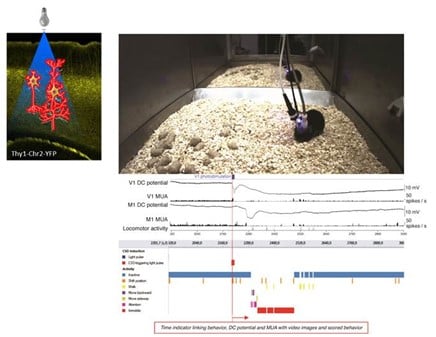
The PDC offers, together with the principal investigator Dr. Tom de Boer, to induce or modulate brain activity in a controlled manner in freely behaving mice, functional tests can be performed in transgenic mice expressing channelrhodopsin2 in deep cortical layers (Thy1-ChR2-YFP mouse). This application includes minimally invasive induction of cortical spreading depolarization (CSD), the correlate of the migraine aura, in freely behaving mice, to investigate brain and behavioral consequences and assess effects of migraine treatments.
…
The PDC offers, together with the principal investigator Dr. Tom de Boer, to induce or modulate brain activity in a controlled manner in freely behaving mice, functional tests can be performed in transgenic mice expressing channelrhodopsin2 in deep cortical layers (Thy1-ChR2-YFP mouse). This application includes minimally invasive induction of cortical spreading depolarization (CSD), the correlate of the migraine aura, in freely behaving mice, to investigate brain and behavioral consequences and assess effects of migraine treatments.
In the figure, traces below the mouse image indicate combined neurophysiological recordings (DC-EEG, neuronal multi-unit activity) across visual (V1) and motor (M1) cortical regions, demonstrating the occurrence of a CSD event by the characteristic deflection in the DC potential following photostimulation in V1.
The ethogram at the bottom shows a representative example of behavior before, during and after CSD induction.
In vivo imaging
Via the pre-clinical imaging facility, we offer access to advanced preclinical imaging modalities, including MRI, SPECT, Bioluminescence, Fluorescence, Ultrasound, Photoacoustics, and CT.
Our service includes expertise in experimental set-up, hands-on training, sample preparation, data storage, and image analysis.
Pathology support
The PDC provides full pathology service for the characterization i.e. phenotyping of genetically altered lines, the diagnosis of disease and to assist with pathology questions in the context of procedures, disease progress and antibody immunohistochemical stainings.
Astrocytes and microglia measurements are standard in our pathology laboratory.
Biotechnical support
PDC offers most frequently used injection techniques such as intraperitoneal, subcutaneous, intravenous injections, oral gavage, and intrathecal and intracerebroventricular injections. Furthermore, technical help could be provided with blood sampling (via tail vein, retroorbital or cardiac collection), CSF sampling, urine collection and tissue sampling.
BSL-I; BSL-II and BSL-III: All biosafety levels are present on the PDC. We house Covid research, Influenza research and all other viral work until BSL-III.
…PDC offers most frequently used injection techniques such as intraperitoneal, subcutaneous, intravenous injections, oral gavage, and intrathecal and intracerebroventricular injections. Furthermore, technical help could be provided with blood sampling (via tail vein, retroorbital or cardiac collection), CSF sampling, urine collection and tissue sampling.
BSL-I; BSL-II and BSL-III: All biosafety levels are present on the PDC. We house Covid research, Influenza research and all other viral work until BSL-III.
Assistance with complex (surgical) procedures is often possible on request.
Hematology support
The PDC offers Hematology support for your experiments. These could be assessed in whole blood.
Room and material desinfection
The PDC has proper validated equipment to disinfect rooms and materials. You could think of, amongst other, fumigated incubators, refrigerators, fume hoods and flow cabinets. Feel free to contact us to get rid of your infection.
Next to animal sciences
The PDC works according to the three R principle: Reduction, Refinement and Replacement (Dutch: Vervangen, Verminderen en Verfijnen). Next to that we are very open about what we are doing and signed the Transparency agreement in The Netherlands, a lot of researchers would like to get out there what they are doing in the field of animal sciences.
…The PDC works according to the three R principle: Reduction, Refinement and Replacement (Dutch: Vervangen, Verminderen en Verfijnen). Next to that we are very open about what we are doing and signed the Transparency agreement in The Netherlands, a lot of researchers would like to get out there what they are doing in the field of animal sciences.
Furthermore we are working together with a lot of in vitro specialists on our annual symposium: Beyond Animal testing (Toezicht en regels dierproeven | LUMC), to share knowledge, increase awareness of all different techniques and the possibilities and impossibilities of all alternative methods.
Contact
Photos by Els van der Hoek