Intensive Care Intensive Care Children's Nursing Ward
Location
Visiting hours
Contact
There are a few reasons why we admit your child to the Intensive Care Unit, namely:
- after major (heart) surgery;
- after a serious accident;
- in case of a severe respiratory infection, pneumonia, or blood poisoning (sepsis);
- in cases of temporary, severe reduction of heart function;
- in cases of severe neurological disorders, such as coma after an accident or resuscitation.
Admission of your child is a significant event for the whole family. A child psychologist can help you process everything you go through during the stay.
…There are a few reasons why we admit your child to the Intensive Care Unit, namely:
- after major (heart) surgery;
- after a serious accident;
- in case of a severe respiratory infection, pneumonia, or blood poisoning (sepsis);
- in cases of temporary, severe reduction of heart function;
- in cases of severe neurological disorders, such as coma after an accident or resuscitation.
Admission of your child is a significant event for the whole family. A child psychologist can help you process everything you go through during the stay.
Parents can stay with their child all day. Even in critical situations, such as resuscitation, parents have the option to stay with their child. The Ronald McDonald House is located close to the hospital. Sometimes parents can also stay in the hospital.
Clothing, stuffed animals, and music
It's nice for your child to have some familiar items around like a favorite stuffed animal, pacifier, toys, or music. For hygiene reasons, we ask you to bring clean, well-washable stuffed animals and wash them once a week and whenever there is visible dirt.
Preparation for a stay in the Intensive Care Unit
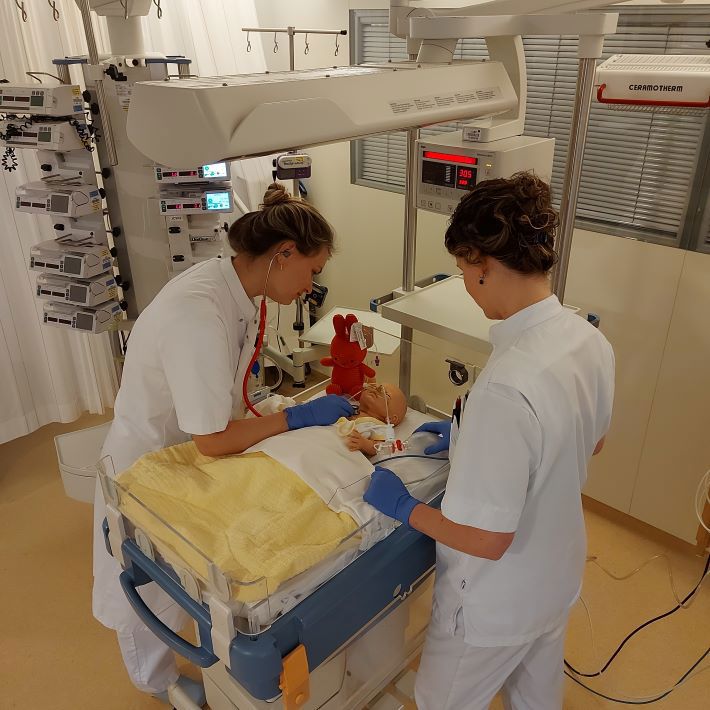
Monitoring of bodily functions
Your child will be monitored extra in the ICU. We pay attention to breathing, heart function, and blood pressure, for example.
For this monitoring (monitoring), we use specialized medical surveillance equipment. As a rule, we pay attention to:
- heart rhythm (ECG = electrocardiogram) and breathing (respiration), measured via electrodes placed on the rib cage;
- the oxygen level of the blood (saturation), measured via a sensor on the finger;
- blood pressure, usually measured via a tube (arterial catheter or arterial line) inserted into an artery in the wrist or groin; sometimes via an 'old-fashioned' blood pressure band (cuff) around the upper arm;
- the temperature, via a sensor on the body;
- urine production, via a tube (bladder catheter or urinary catheter) that we insert through the urethra into the bladder.
In addition, we may also monitor other bodily functions, such as:
- the pressure in the major veins (CVD = central venous pressure) or the pressure in the pulmonary artery (pulmonary pressure). We measure this via a tube (central venous catheter) that is pushed up through the neck, under the collarbone, or through the groin far into the major blood vessels;
- the ventilation values, if your child cannot breathe independently or insufficiently. Your child then has a tube (endotracheal tube) inserted through the mouth or nose into the trachea. We connect a ventilator to this tube to support and monitor breathing.
Support for bodily functions
For the treatment or support of non-functioning organs, we also use specialized medical equipment. With this, we can temporarily support or fully take over organ functions, for example the heart, lungs, and kidneys.
Some examples of this are:
- The function of the lungs is supported by a ventilator. This device blows air with an increased oxygen content into the lungs.
- Heart function and blood pressure are supported with medications administered directly into a blood vessel via a tube (intravenous catheter) (intravenous administration)
Aftercare Intensive Care
Within the intensive care children (ICK) of the LUMC, we offer aftercare to patients and their parents who have been admitted to the ICK for 5 days or longer.
Discharge to the pediatric ward is a step toward recovery. At the ICK, the child required intensive care due to illness or surgery.
Admission to the ICK can have a major impact. It is often experienced as a 'rollercoaster' where emotions and questions only arise later, after discharge to the pediatric ward.
…Aftercare Intensive Care
Within the intensive care children (ICK) of the LUMC, we offer aftercare to patients and their parents who have been admitted to the ICK for 5 days or longer.
Discharge to the pediatric ward is a step toward recovery. At the ICK, the child required intensive care due to illness or surgery.
Admission to the ICK can have a major impact. It is often experienced as a 'rollercoaster' where emotions and questions only arise later, after discharge to the pediatric ward.
About 3 to 5 days after discharge to the pediatric ward, an ICK aftercare nurse visits the parents and child to discuss the admission and its impact. He/she can answer questions and talk about events in the ICK. In this way, we hope to help process the ICK admission for both the parents and the child.
If parents or the child wish, a follow-up phone interview can take place three months after discharge.
The website www.nahetziekenhuis.nl offers tips for parents and children on how to cope with stress after a hospital stay.
If you have any questions after reading this information, you can reach the aftercare nurse via the email address: nazorgic@lumc.nl
Appointments for visits
- It can be stressful for the patient and the environment if you visit too often and for too long as a visitor.
- Therefore, a maximum of 2 people may be present with the patient at the same time; a total of up to 4 visitors can take turns at the bedside.
- To prevent the spread of infections, we ask you to disinfect your hands with hand sanitizer before and after your visit to the patient. You can find the hand sanitizer pumps at the entrance of the ward and at the entrance of each patient room.
- Seek advice from the nurse if you feel ill and may be contagious to the patient.
- For some patients, extra hygiene measures apply because they (possibly) have a contagious infection or because they themselves are susceptible to infection due to reduced immunity. In that case, you can see at the room door which measures apply when entering and leaving the room.
- Brothers and sisters from the age of 1 are welcome, accompanied by their parents and provided that they:
- Be vaccinated according to the National Vaccination Program;
- have had chickenpox;
- not having a cold.
- If you want to prepare your child for a visit to a brother or sister in the ICU, you can help them with the information book Visiting Your Brother or Sister in the Intensive Care Unit.
- Flowers and plants or fruit and fresh food are not allowed.
- Due to limited space, we ask you to take a seat in the waiting room with no more than 4 visitors per patient during visiting hours. Other visitors and outside visiting hours are asked to use the general facilities at Leidse Plein on the 2nd floor.
- Due to limited space, we ask you to take a seat in the waiting room with no more than 4 visitors per patient during visiting hours. Other visitors and outside visiting hours are asked to use the general facilities at Leidse Plein on the 2nd floor.
- We have several rooms in the ward where family members can temporarily and in consultation with the ICU staff use to stay close to the patient.