Childhood stem cell transplantation and cell therapy
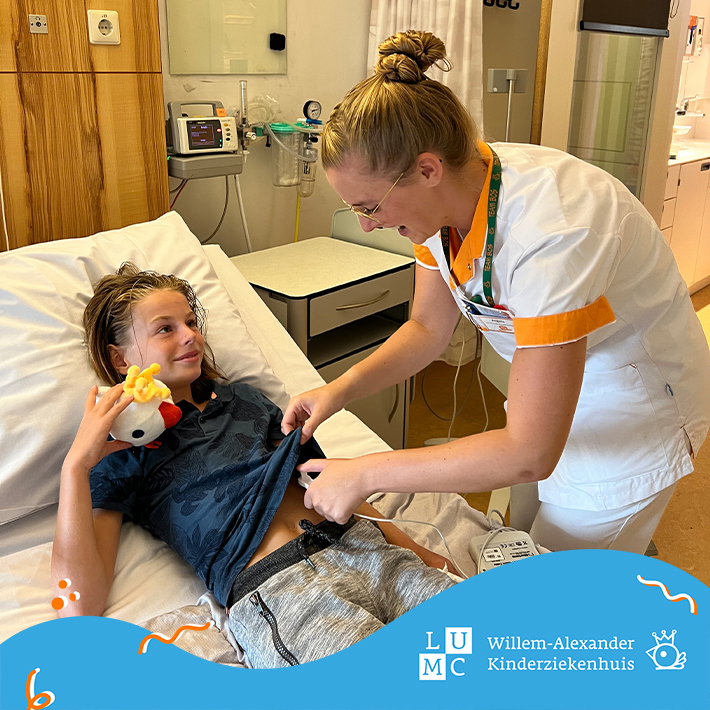
About our transplant department
In 1968, the first successful stem cell transplant in Europe was performed in Leiden on a baby. This was in a baby with the rare immune disease SCID. You can watch a video here about '50 years of stem cell transplantation'.
Nowadays, we also transplant children with various other diseases. For example, sickle cell disease. Children with (blood) cancer who need a stem cell transplant are treated at the Princess Máxima Center (PMC). We work closely with the PMC. We also collaborate extensively with other hospitals in the Netherlands and the rest of Europe. Our transplant program is JACIE-accredited (Joint Accreditation Committee ISCT-Europe & EBMT).
See also the information about Our Team.
"It's good that the child is allowed to think along and that we got a sense of control."
What is a stem cell transplant?
In a stem cell transplant, diseased stem cells are replaced by healthy stem cells from someone else (a donor). First, the patient's own stem cells are destroyed. This is done through chemotherapy and immunotherapy.
You can read more about this in our patient brochures.
When is a stem cell transplant a good treatment?
This depends on many things:
- Which illness the child has.
- How much trouble the child has from the disease.
- Whether there is another way to treat the disease.
- Sometimes a transplant is too great a risk.
We discuss this with the doctor who knows the child well (the referrer). We also discuss it with colleagues. Ultimately, we make a decision together with the child and the parents.
You can read more about this in our patient brochures.
Watch our YouTube Shorts here with explanations about the stem cell transplant:
Stem Cell Transplantation Symposium
Which children can receive a stem cell transplant?
Children with the following diseases can receive a stem cell transplant at the Willem-Alexander Children's Hospital:
Hemoglobinopathies (diseases of red blood cells), for example:
- sickle cell disease
- beta-thalassemia
See also the video on Cyberpoli with Dr. Smiers
Bone marrow diseases, for example:
…Children with the following diseases can receive a stem cell transplant at the Willem-Alexander Children's Hospital:
Hemoglobinopathies (diseases of red blood cells), for example:
- sickle cell disease
- beta-thalassemia
See also the video on Cyberpoli with Dr. Smiers
Bone marrow diseases, for example:
- Severe aplastic anemia (SAA)
- Blackfan Diamond anemia (BDA)
- Severe congenital neutropenia (SCN)
- Other rare genetic bone marrow diseases
Diseases of the immune system, for example:
- Hemophagocytic lymphohistiocytosis (HLH)
- Severe combined immune disorder (SCID)
- Chronic granulomatous disease (CGD)
- Interferon gamma receptor deficiency
- Other serious, rare immune diseases
- Very severe autoimmune diseases
For some children with cancer or metabolic diseases, a stem cell transplant is also a good treatment. For these children, this is done at the Princess Máxima Center for Pediatric Oncology.
Where do the new stem cells come from?
In an "allogeneic" stem cell transplant, children receive healthy stem cells from a donor. Sometimes a family member can be a donor, for example a brother, sister, or one of the parents. If that is not the case, we search a global database for the most suitable donor.
You can read more about this in our patient brochures.
For some diseases, children receive their own stem cells back. This is called an "autologous" stem cell transplant.
Chemotherapy and immunotherapy
In a stem cell transplant, space must be created in the bone marrow for the donor's new stem cells. This is done with chemotherapy. Usually, a medication against immune cells is also needed. This is immunotherapy.
You can read more about this in our patient brochures.
Information video about stem cell transplantation for sickle cell disease
Appointment and admission
Admission for stem cell transplantation
Children usually stay in the Willem-Alexander Children's Hospital for two months for a stem cell transplant. Sometimes the admission lasts even longer. During treatment, the child must be extra protected against diseases. This is called 'isolation'. The admission for stem cell transplantation is at the Strand ward. Click here for the beach ward.
Visit to the outpatient clinic
It is important that the child visits the doctor regularly. The doctor then checks how things are going. In the first period after the transplant, we see the children at the clinic every week for check-ups. After that, this happens less and less. The outpatient check-ups take place at the Stad pediatric clinic.
Day recording
It may be that your child still needs to receive other medications in the hospital. The medication is given by infusion. Your child will then be admitted for one day, usually at the pediatric clinic in Stad.
Late effects and follow-up
From two years after transplantation, children are seen at the LEEF outpatient clinic (Late Effects and Follow-up). This is initially with a pediatrician, and from 18 years old with an internist.
Scientific research
Scientific research
In our department, we conduct extensive scientific research on stem cell transplantation in children. The goal of our research is to continuously improve and make the treatment safer. See the Research page for a comprehensive overview of our research.
Some examples of our scientific research:
- We investigate how the immune system functions after transplantation.
- We are investigating which chemotherapy or immunotherapy is best.
- We are researching new therapies, such as gene therapy.
- We are investigating how to prevent and treat graft-versus-host disease.
- We are investigating the best treatment for children with specific diseases, such as sickle cell disease or hemophagocytic lymphohistiocytosis (HLH).
- We are investigating the late effects of a stem cell transplant in children with blood or immune diseases.
Patient brochures
The overview below lists all brochures about stem cell transplantation divided into different phases.
Preliminary phase
Hospital admission - preparation
Supportive care
Stem cell transplantation
Preparing to go home
Monitoring at the outpatient clinic
Polyclinic Live
Other brochures
50 years of stem cell transplantation
How scientists in Leiden have further made stem cell transplantation possible.
Our team
Stafartsen:
Prof. Dr. Arjan Lankester
Child immunologist/infectiologist
Professor of pediatrics, especially stem cell transplantation
Areas of focus: gene therapy, CTLA-4 haplo insufficiency, STIM-1 deficiency
Dr. Federica Achini
pediatric hematologist
Areas of focus: benign hematology, hemoglobinopathy
Dr. Robbert Bredius
Child immunologist/infectiologist
Areas of focus: SCID, MSMD/interferon gamma receptor deficiency, chronic granulomatous disease (CGD)
Dr. Dagmar Berghuis
Child immunologist/infectiologist
Areas of focus: SCID, gene therapy, ICF syndrome
Dr. Alexander Mohseny
pediatric hematologist
Areas of focus: acquired bone marrow failure/SAA (severe aplastic anemia), sickle cell disease
Dr. Emmeline Buddingh
Child immunologist/infectiologist
Areas of focus: HLH, STAT1/STAT3 mutations, GVHD
Dr. Anne de Pagter
pediatric hematologist
Focus areas: late effects and follow-up, value-driven care
Fellows:
Dr. Carolien Haazendonk
Fellow pediatric hematology
Area of focus: hematology
Dr. Gertjan Lugthart
Fellow pediatric hematology
Area of focus: hematology
Dr. Lisa Ott de Bruin
Fellow in Pediatric Immunology/Infectious Diseases
Areas of focus: SCID, gene therapy
Nurse specialists:
Trude Minnee
Nurse Specialist
Focus area: outpatient care after stem cell transplantation, transition to adult care
Judith Timmermans
Nurse specialist in training
Area of focus: hematology