Nursing Department Neurology, Neurosurgery, Neuro Care and Psychiatry (VNNP)
Location
Visiting hours
Contact
The nursing ward is characterized by care for patients from both neurology and neurosurgery. Patients from both specialties are cared for together. Within the ward, there is a special neurocare unit for people who require extra monitoring and intensive care. In practice, this means we keep the environment as calm as possible, among other things by maintaining short visiting hours.
At the Department of Neurology at LUMC, we treat patients with neurological deficit, muscle weakness, epileptic seizures, headaches, myasthenia gravis, and acute deterioration of neurological function.
At the Department of Neurosurgery at LUMC, you can receive surgical care for diseases of the brain, spinal cord, spine, and peripheral nerves.
The department is part of the University Neurosurgical Center Holland (UNCH). More information can be found on the UNCH website.
Contact person
The nurse asks you to designate one or two contact persons upon admission. We only provide information about your health status to the contact persons. If the contact person wants information from a nurse, this can be done during the visiting hour. If desired, appointments will be made with the contact person when we call.
Our employees
Nursing team
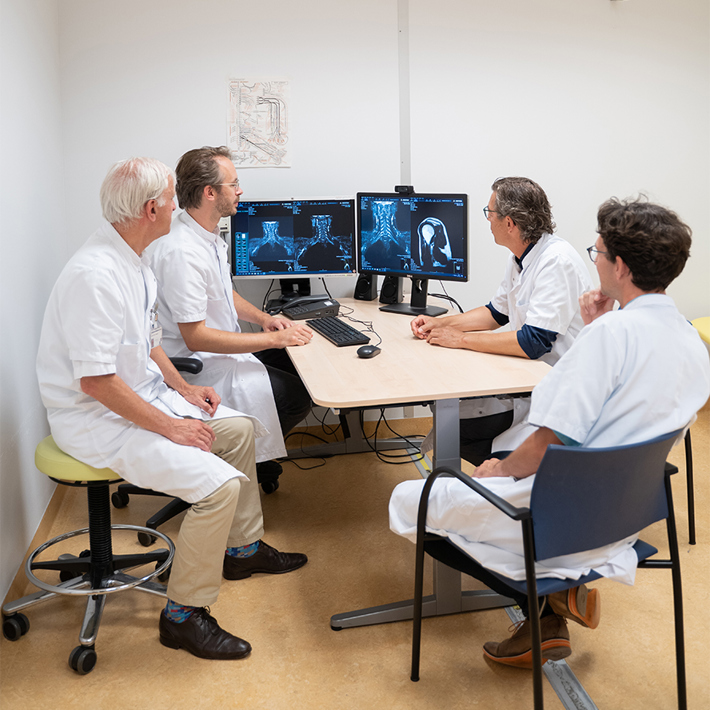
The Neurology Department employs a dedicated nursing team, consisting of:
…Contact person
The nurse asks you to designate one or two contact persons upon admission. We only provide information about your health status to the contact persons. If the contact person wants information from a nurse, this can be done during the visiting hour. If desired, appointments will be made with the contact person when we call.
Our employees
Nursing team
The Neurology Department employs a dedicated nursing team, consisting of:
- A nursing manager
- Team Leaders
- Nurses
- Nursing students
The nurses are specially trained to properly support patients with neurological disorders. The team leaders are in daily charge of the team. Work is done in three shifts per day. As a result, you will have to deal with multiple nurses during your admission. Where possible, we try to ensure that the same nurse provides you with multiple shifts in succession.
Medical team
Medical care in the ward is provided by a team of:
- Neurologists – they are responsible for your daily medical treatment.
- Physician assistants (ward doctors) – they provide medical care under the supervision of specialists.
- Physician assistants – they also work as ward doctors and are part of the treatment team.
- Assistant physicians – they are doctors in training and are doing internships in the department.
The head of department is ultimately responsible for medical policy.
The nursing and medical team works closely with other experts, such as:
- Physiotherapists
- dietitians
- occupational therapists
- Speech therapist
In addition, you can also come into contact with the following in the department:
- Department secretaries
- Nutrition assistants
- Interior Care Specialists
- Social workers
- Spiritual caregivers
A large portion of our neurology patients are admitted urgently. Within 24 hours after admission, we schedule a family meeting in which we inform the partner and/or children about the medical condition and the expected discharge date.
We believe it is important that the patient retains as much control as possible. This means that we do not simply take over care, but rather encourage and motivate the patient to remain active themselves. Only when it is truly necessary does a healthcare professional (partially) take over care.
…A large portion of our neurology patients are admitted urgently. Within 24 hours after admission, we schedule a family meeting in which we inform the partner and/or children about the medical condition and the expected discharge date.
We believe it is important that the patient retains as much control as possible. This means that we do not simply take over care, but rather encourage and motivate the patient to remain active themselves. Only when it is truly necessary does a healthcare professional (partially) take over care.
To properly support this, various healthcare providers work together in our department. Think of: nurses, caregivers, neurologists, neurosurgeons, rehabilitation physicians, physiotherapists, speech therapists, occupational therapists, dietitians, and service staff.
The patient's daily schedule is tailored to a good balance between rest and effort. Where necessary, this schedule is adjusted to the individual situation of the patient.
If necessary, we consult with the first contact person about measures such as rooming-in (a close relative who temporarily stays overnight with the patient) or the use of freedom-restricting interventions. This happens, for example, when there is a risk of falling, if the patient is difficult to instruct, or if there is a risk of wandering behavior.
The ward also has a living room where patients, under the guidance of volunteers, can find relaxation or to eat a meal together.
In some situations, the patient is monitored with a monitor that monitors vital signs.
Doctor's round
During an admission to the Neurology department, the ward doctor will inform you about your treatment. In most cases, the ward doctor is a different doctor than the one you met at the outpatient or emergency room. In the evenings and on weekends, you may see a substitute doctor.
There is a daily doctor's round in which all patients are discussed. This round ends with a round of the beds.
If you or your contact person would like to have a conversation with the doctor, you can indicate this through the secretary or nurse.
Medications
The times you take your medication may differ from what you are used to at home. Depending on your situation, your medication is given by tablet, via IV, or by tube.
You may receive different medications than you are used to. This is because the hospital pharmacy does not supply the usual brand name medicines. You will then receive a replacement medication with the same effect. It is advisable to bring your home medication for the first 2 days. Use of your own medication is only possible in consultation with the ward doctor.
Mixed catering
Mixed care is provided in the nursing ward; this means that men and women share one room. If you object to this, you can express this to the nursing staff. We will take your wishes into account as much as possible.
Daily operations
A number of tasks in the nursing ward follow a fixed routine, such as physical care, doctor rounds, meals, check-ups, and medication administration.
Examinations, treatments, and other appointments may be scheduled throughout the day. It is important that you are present on the ward at those times. If medically justified, you may leave the ward after consulting with the nurse. For your safety and insurance reasons, you may not leave the LUMC premises and must be provided with an identification wristband.
Upon dismissal, you will receive rules of conduct and instructions on when you may contact the department for which complaints.
Dismissal procedure
We strive to provide you and your loved ones with clarity about the expected recording duration at the start of the recording.
Dismissal to a follow-up institution
If you are transferred to another care institution after your admission (for example, a rehabilitation or nursing home), a discharge meeting will take place beforehand with the doctor or nurse. In this meeting, we discuss how you experienced the admission, there is room for questions, and you will receive explanations or instructions where necessary.
The aim is to have the discharge take place around 10:00 AM. You will not receive prescriptions. The GP will receive a discharge letter and you will receive an appointment at home for a possible outpatient check-up.
Dismissal home
If you go directly home, we will have a conversation with you on the day of discharge, usually with the doctor and/or nurse. We will also discuss how you experienced the admission, allow space for questions, and provide explanations or instructions where necessary.
Discharge preferably takes place at the end of the morning or the beginning of the afternoon. You will receive prescriptions if necessary. In this case as well, a letter will be sent to your general practitioner and you will receive an appointment at home for a possible follow-up at the outpatient clinic.
Visitors and loved ones
If a patient undergoes surgery, we call the first contact person as soon as the operation is completed. This does not mean the patient has already returned to the ward. Would you like to visit after the operation? Then ask the nurse during admission what a realistic time to come by. This may vary depending on the situation.
After surgery, the first contact person is called to confirm that the operation is finished. This does not mean the patient has already returned to the ward. During admission, ask the nurse what is realistic regarding visits after the OR.