‘With this approach, you can prevent so much suffering on such a large scale’
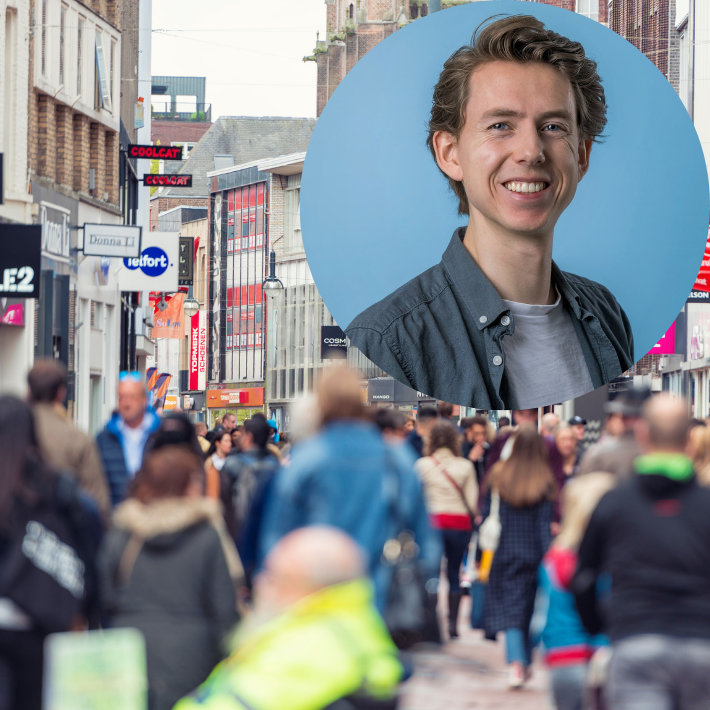&width=710&height=710 "A lot of people in the shopping street, attached: Sam Hundersmack")
“I studied Medicine at bachelor level. During that time, I enjoyed my clinical placement and the patient contact the most. At the same time, I increasingly felt that some of the healthcare issues I encountered could have been addressed much earlier and in a more efficient way. With this approach, you can prevent so much suffering on such a large scale. That made me want to focus more on preventing illness rather than treating people who are already ill. That was the deciding factor for me to step away from a clinical career. It wasn’t an easy decision, because it meant I would have less direct patient contact. But in the end, being able to make impact on a larger scale mattered more to me.”
"During my bachelor’s programme, I also noticed that our healthcare system can still be very fragmented. Collaboration and the exchange of information within and outside the hospital do not always run smoothly. For patients, this means that when they are referred, they often have to tell their story again, and continuity of care and support is not guaranteed, which can be very burdensome. They also do not always receive the help they need, but rather the help that happens to be available at that moment. I wanted to change something about that."
Staying healthy and getting better
"The master’s programme Population Health Management is strongly focused on improving this system, with a population (a group of people who share similar characteristics) at the centre. Population Health Management is a method for making improvements: you start from a problem or need within a population and organise everything around what that group requires. You can use this not only to prevent illness. You can also use it to ensure the right support is provided so that a problem does not become worse. That requires a broad perspective, which I find very interesting."
"Different perspectives are essential for that broad view. Because students from many different backgrounds came together in our master’s programme, I immediately encountered a wide variety of perspectives and experiences. That was one of the aspects I enjoyed most. You meet students who studied biomedical sciences, health sciences, psychology or even history. This allows you to benefit from each other’s strengths. It broadens the narrow view you may have developed up to that point. There are also many international students. This means you not only learn about the Dutch system, but you also gain foreign perspectives where healthcare is sometimes organised very differently. That added an extra dimension and was very refreshing."
Regional collaboration
"What the master’s programme does very well is give you the freedom to follow your own path. In the first year, you get to know the core aspects of population health management. In the second year, you can almost entirely shape your own programme, within certain boundaries, based on the areas you want to develop further. This led me to explore the policy side more. I enjoy figuring out why something works (or does not), why we do things a certain way, and what is needed to change it."
"You can see this in the PhD project I am now doing at the RIVM and the Health Campus in The Hague. It focuses on the transformation from care to health through regional collaboration. So in essence: how can cross-domain regional partnerships create positive change in a region? These are collaborations between organisations from different sectors (such as hospitals, general practitioner organisations, municipalities and social welfare organisations) that work together to improve health."
"I am currently researching what is happening within these partnerships and what practical challenges they face. For example, when developing new working methods, funding models, governance structures or data infrastructures. But also when improving mutual trust and creating a shared vision. I also examine how this relates to national policy, with the aim of contributing to support that better fits what is actually needed to advance regional transformations."
"What I also find interesting is that these collaborations are becoming increasingly broad. It is no longer only about healthcare, but also about education, living environments and involving residents directly. Since health is largely determined by factors outside the healthcare system, the focus is shifting more towards the front end. This means there is more attention for what is needed to keep people as healthy as possible. Think of prevention and early detection, but also of improving coordination between organisations. This allows support to be offered earlier and helps slow the growing demand for care."
Future
"What the master’s programme has mainly given me is exposure to many different perspectives that are important for promoting and supporting the health of a population. It has become a continuous way of thinking that I always keep in mind: what are the local needs, what expertise and resources does that require, and how can we organise this sustainably together?"
"I am not yet sure which direction I want to take in a few years. Policy advice is what I currently find most interesting. I would enjoy being involved early in the process and having influence at that level. At the same time, I would also like to stay connected to practice."
Are you unsure whether the master’s programme Population Health Management is right for you? Visit the website or send Sam Hundersmack a message on LinkedIn.
Faculty of Medicine: more than medicine
The master’s programme Population Health Management is part of the Faculty of Medicine of the LUMC and Leiden University. The faculty trains students to truly make a difference, especially now that healthcare is under pressure and health inequalities are increasing.
"This requires broad expertise: from care and prevention to research and innovation, focused on societal challenges and supported by technology and data. That is why the faculty offers a wide range of master’s programmes: Medicine, Biomedical Sciences, Health, Ageing and Society, Population Health Management, Technical Medicine, Pharmacy, Transfusion Medicine and Cellular Tissue Therapies, and Statistics and Data Science. Explore which bachelor’s or master’s programme suits you."

&width=710&height=710)
&width=710&height=710)
&width=710&height=710)