‘I see myself as someone who brings two worlds together’
&width=710&height=710)
Master’s student Michelle Geertse is researching how technology and management can work together to improve healthcare. She wants to understand not only the technology, but also its broader impact on the hospital and society."
You completed a bachelor’s degree in Clinical Technology. What made you choose that programme at the time?
“Our healthcare system is under pressure: doctors often have just ten minutes per patient, including administrative tasks. There is a shortage of staff, and while technology can help, implementation is often slow because of regulations and organisational structures. Clinical technologists can add value here. We understand both the technology and clinical practice, and can help departments work more efficiently. For me, that is how you create real impact. I believe healthcare is going to change, and technology will play a major role in that. But technology alone is not enough: you also need people who can translate it into policy and organisational practice.”
You are now combining Technical Medicine and Health Care Management. In your view, what is the added value of doing both master’s programs?
“During my bachelor’s in Clinical Technology, I found the combination of people and technology fascinating, but I missed the bigger picture. You learn a great deal about how the human body works and how technology can help, but less about why certain decisions are made in healthcare. Why do we do things the way we do, and why are some things possible while others are not? I wanted to understand that better. That is why I decided to take the one-year master’s in Health Care Management in Rotterdam alongside my studies, spread over two years. It allows me to complement my technical knowledge with insights into policy, economics and organisation.”
That sounds like a demanding schedule. What does your daily life as a student look like?
“Some days are long, but because I find the subject matter so interesting, it is manageable. I knew in advance that it would be intensive, and that helps. I plan everything very precisely: which tutorials I attend, which ones I can review later, and how I combine lectures in Delft, Leiden and Rotterdam. That makes it feasible. I like having control over my schedule, because it also gives me peace of mind.”
Can you give a concrete example of how you apply this broad knowledge in practice?
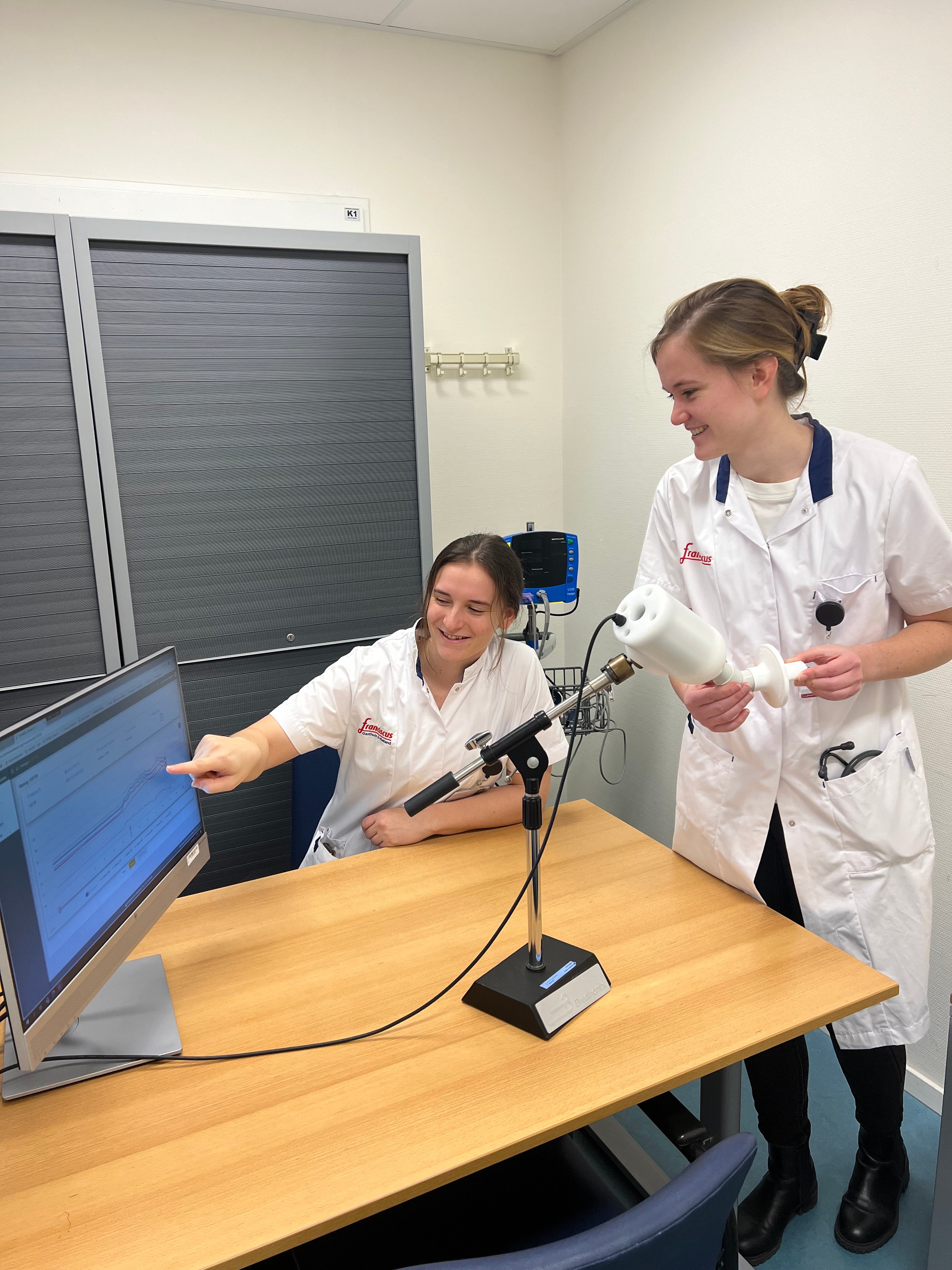
“During my internship at Franciscus, I worked on a machine learning model to predict whether asthma patients would respond to prednisone. A technician can build an excellent model, but without clinical knowledge, implementation is difficult. Conversely, a doctor knows a great deal about the patient, but not how to develop such a model. As a clinical technologist, I can connect those two worlds. I do not only look at the technology, but also at the clinical impact: what does this actually deliver for the patient, for the department and for the hospital?”
What do you notice in practice about the role of clinical technologists?
“Because it is still a relatively new programme, many people do not yet fully understand what clinical technologists do. We are often described as a ‘bridge’ between technology and medicine, but I see myself as someone who brings those two worlds together. That holistic perspective allows you to identify problems that others may overlook. You can develop solutions that have an impact across the entire hospital, for example by making processes more efficient or by implementing technology in a way that truly works in practice.”
What kind of societal impact do you hope to make yourself?
“I would find it very rewarding if technology could be used not only to help individual patients, but also to contribute to broader societal solutions. At Franciscus, I saw how many people struggle with asthma and how significant that problem is for society. If you can develop a technical solution that can be applied on a large scale, you are not just improving a few lives, but enhancing healthcare for thousands of people.”
The bachelor’s programme Clinical Technology and the master’s programme Technical Medicine are a collaboration between Delft University of Technology (TU Delft), Leiden University (LUMC) and Erasmus University Rotterdam (Erasmus MC). These three world‑class centres work together in the Medical Delta in the field of clinical technology. Their advanced research facilities and extensive expertise make this an interesting environment to study in.
The Faculty of Medicine at LUMC/Leiden University trains students to truly make a difference, especially now that healthcare is under pressure and health inequalities are increasing. This requires broad expertise: from care and prevention to research and innovation, focused on societal challenges and supported by technology and data. Explore which bachelor’s or master’s programme suits you.

&width=710&height=710)
&width=710&height=710)
&width=710&height=710)