New platform to accelerate cardiac drug development
A cake to celebrate the publication. f.l.t.r. Ben Johnson (LUMC), Benoit Samson-Couterie (Ncardia), Tessa de Korte (LUMC), Richard Davis (LUMC), Christine Mummery (LUMC), Loukia Yiangou (LUMC)
&width=710&height=710 "A cake to celebrate the publication. f.l.t.r. Ben Johnson (LUMC), Benoit Samson-Couterie (Ncardia), Tessa de Korte (LUMC), Richard Davis (LUMC), Christine Mummery (LUMC), Loukia Yiangou (LUMC)")
Congenital cardiac arrhythmias are inherited disorders of the heart’s electrical system and can lead to life-threatening rhythm disturbances or sudden cardiac death. Although each condition is rare, together they affect approximately 1 in 2,000 people worldwide. For many patients, effective treatment options are still limited.
Stem cell models of the heart
To develop better therapies, it is essential to study heart diseases in models that closely reflect human heart biology. Human pluripotent stem cells offer unique opportunities in this respect.
Richard Davis, group leader at LUMC and Associate Investigator at reNEW Leiden, explains: “Pluripotent stem cells can multiply indefinitely and be directed in the laboratory into almost any cell type in the body. In our group, we use them to generate heart cells which allow us to study cardiac arrhythmias and develop new treatments in a human-relevant model.”
From simple cells to 3D microtissues
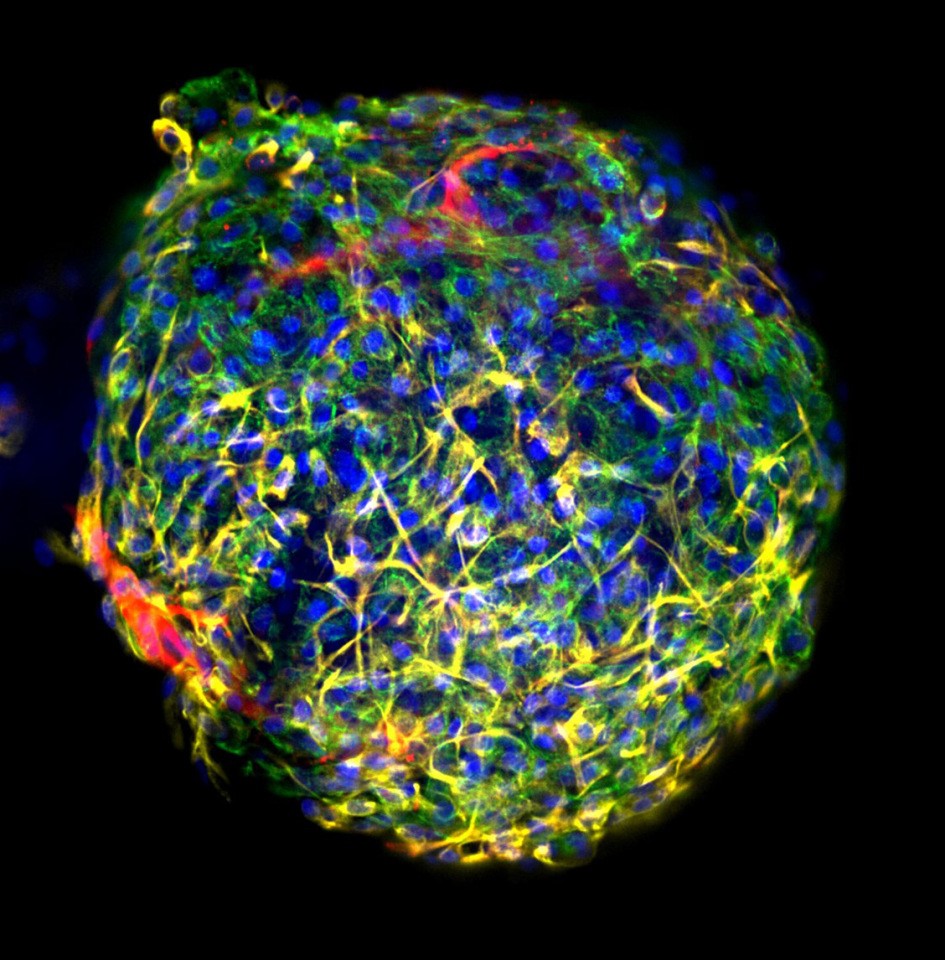
In recent years, cardiac stem cell models have become increasingly complex. “Early models consisted of a single layer of heart muscle cells,” says Davis. “Today, we create small 3D structures containing multiple cardiac cell types. These structures, also known as cardiac microtissues, more closely reflect the human heart.” Using fluorescent dyes that respond to calcium signals or electrical activity, researchers can monitor the beating behavior of these microtissues in great detail and study how drugs influence heart rhythm.
Picture of a 3D-structure made with fluorescence microscopy: nuclei (blue), cardiac muscle cells (green), fibroblasts (yellow) and endothelial cells (red)
Importantly, the researchers showed that these 3D micro tissues can predict drug-induced effects on heart function at a level comparable to more labor-intensive 3D heart models. At the same time, the microtissues are generated in a standardized and reproducible format, making them suitable for both drug safety testing and drug discovery applications.
Scaling up through automation at the Leiden Bio Science Park
Together with Ncardia (formerly LUMC spin-off Pluriomics), the researchers automated the production and analysis of these cardiac microtissues using robotics and machine-learning pipelines. This step was essential, as many advanced 3D heart models are expensive and require specialized equipment and expertise, limiting their use in large-scale drug testing.
“By combining LUMC’s deep expertise in stem cell–based cardiac disease modelling with Ncardia’s automation, manufacturing, and analytics capabilities, we have created a scalable platform that brings human-relevant cardiac biology into early drug discovery,” says Shushant Jain, Director at Ncardia. “This collaboration allows us to bridge the gap between academic innovation and industrial application, enabling faster and more predictive cardiac safety testing and therapeutic discovery”.
Screening more than 2,000 compounds
Using the automated platform, published in Trends in Biotechnology, the team screened more than 2,000 FDA-approved compounds in a model of catecholaminergic polymorphic ventricular tachycardia (CPVT1), a severe inherited cardiac arrhythmia. Through this large-scale screen the researchers identified around 100 compounds that were able to correct abnormal heart rhythms in the model.
These compounds are now being studied further to assess their potential as future therapies for patients.
Potential applications
The platform can be used for a wide range of applications. These include testing the cardiac safety of new drugs and studying the harmful effects of chemical substances on human heart tissue.
The technology may also open new possibilities for patients who do not respond to standard therapies, a group for whom treatment options remain limited. “Using stem cells from individual patients, we can generate personalized cardiac microtissues,” says Davis. “This brings us closer to tailoring treatments to the individual patient.”
LUMC is part of the Leiden Bio Science Park, an ecosystem where companies and research institutions work together on biotechnology and the development of new medicines. Here, talent, startups, businesses, and researchers collaborate every day to bring innovations to patients faster. Step by step, we improve healthcare and make the world a little healthier.
The collaboration was supported by the Province of Zuid-Holland through a Campus subsidy, with additional research support at LUMC from the Novo Nordisk Foundation Center for Stem Cell Medicine (reNEW).

&width=710&height=710)
&width=710&height=710)
&width=710&height=710)