Four LUMC researchers receive prestigious Vidi grant
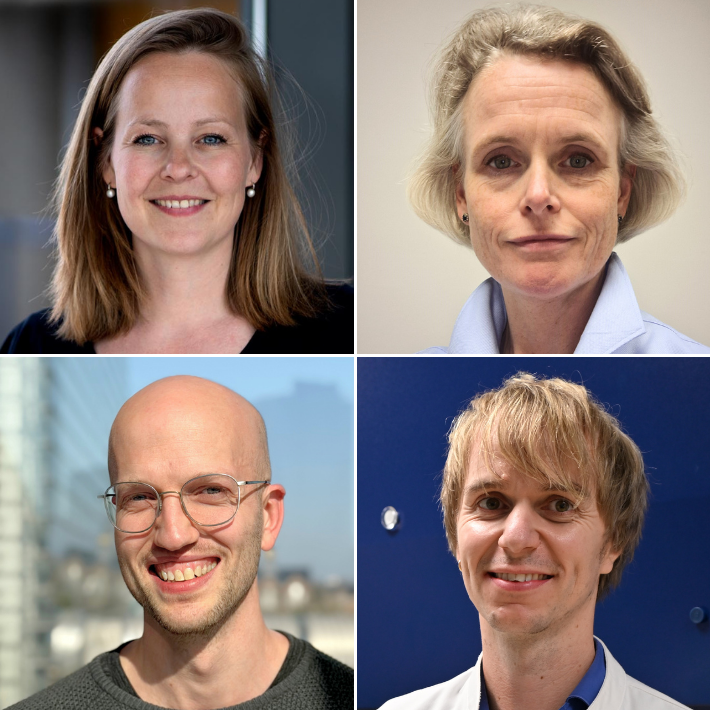
Prof. dr. Maartje Huijbers, dr. Rachel Knevel, dr. Luuk Loeff and dr. Vincent van Unen.
The secret recipe of an immune system gone rogue
Autoimmune diseases arise when the immune system attacks the body’s own tissues. Despite advances in knowledge and treatment, many patients still experience severe symptoms, and disease severity and treatment response vary widely. In this project, prof. dr. Maartje Huijbers, research group leader in the Department of Human Genetics and Neurology, is investigating how these differences among patients arise by using advanced techniques to analyze the exact mixture of harmful antibodies in the blood.
It also maps how these antibodies disrupt normal bodily functions. In addition, a new model that mimics chronic autoimmune diseases will be developed to test therapies more realistically. The results may contribute to improved diagnostics and more personalized treatments.
The silent road to rheumatism
Rheumatic diseases are auto-immune diseases that begin years before the first symptoms appear. Early symptoms are subtle and indistinguishable from common musculoskeletal problems, which makes it difficult to study how the disease develops. In this project, rheumatologist dr. Rachel Knevel, who has a background in genetics and bioinformatics, is developing computer models that learn to recognize early warning signs in routine medical records such as visits to the primary care physician, lab results, and clinical notes, long before a patient is referred to a specialist.
The model updates its risk estimate at every healthcare contact and suggests additional examination when helpful. The model will support research and trials that can prevent rheumatic diseases. The approach can also be applied to other rare conditions.
How bacteria detect viral DNA by its shape
Bacteria are constantly attacked by viruses and use immune systems to destroy invading DNA. Most known systems recognize specific DNA patterns, but recent work suggests that some instead detect the shape of DNA.
In this project, dr. Luuk Loeff, a researcher in the Department of Cell and Chemical Biology, will investigate how bacteria use DNA structure to distinguish viral DNA from their own and how viruses evolve ways to escape this detection. By combining structural biology, biochemistry, and infection experiments, this research will uncover new ways the immune system recognizes threats and may inspire future tools for biotechnology and making precise changes to DNA.
Why the gut stays inflamed in Crohn’s disease and colitis
The prevalence of Crohn’s disease and ulcerative colitis is rising worldwide. In many patients, gut inflammation persists despite treatment. The hypothesis of immunologist and researcher dr. Vincent van Unen is that a specific group of intestinal immune cells plays a key role in this ongoing damage.
This project will investigate how these cells malfunction, why some patients do not respond well to therapy, and how this process might be redirected. Using gut biopsies, advanced cell analysis, and mini-gut models, the researchers aim to identify new leads for more targeted treatment and to better predict which therapy will work for which patient.
Veni Vidi Vici
The Vidi grant is part of the NWO talent program Veni Vidi Vici, under which the Vidi is awarded to researchers who are in the process of transitioning into leadership roles. With the funding provided by the Vidi, they can further expand their own line of research and research group.
The projects receiving funding focus on a wide variety of topics. This year, the NWO awarded 109 Vidi grants, with the healthcare research and medical sciences domain administered by ZonMw



