LUMC Strengthens Collaboration with Japan in Research and Education
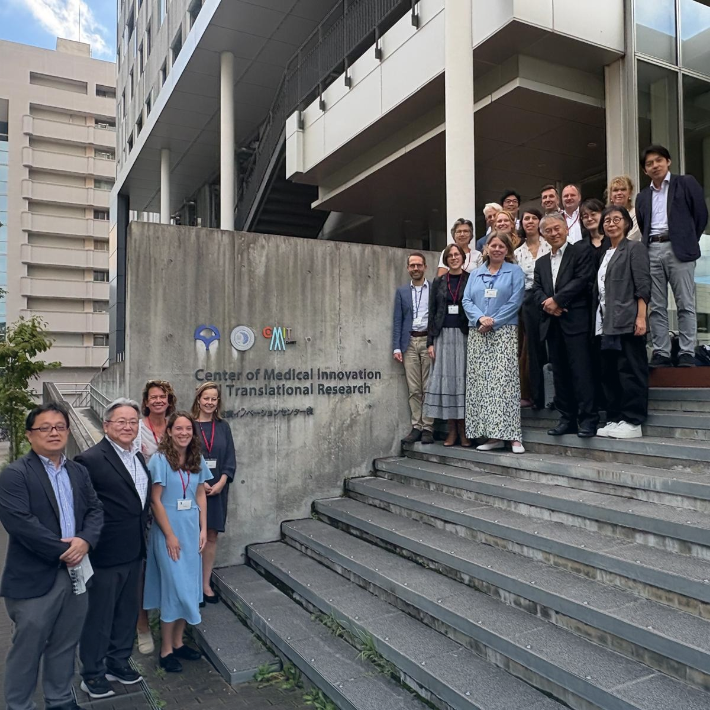
International collaboration brings together the knowledge and expertise needed to develop new treatments and innovations. The visits build on existing relationships and create opportunities for new initiatives, ranging from research internships for students to technologies that support surgeons during operations.
Nagasaki University Becomes an LUMC Global Partner
During the fourth Leiden-Nagasaki Joint Symposium on 1 and 2 October, researchers from both institutions shared their findings and explored new opportunities for collaboration. The relationship between Leiden and Nagasaki has a long history and continues to grow through connections between researchers, students, and both universities.
With the designation of Nagasaki University as an LUMC Global Partner, this collaboration receives an additional boost. The partnership helps connect research groups, promote knowledge exchange, and develop joint initiatives.
To mark the occasion, university president Takeshi Nagayasu received a handmade ceramic key. The gift is inspired by the red keys featured in the coat of arms of the city of Leiden and incorporates a kidney and the letters LUMC.
Read the symposium report on the Nagasaki University website.
More Opportunities for Students
The collaboration also offers many opportunities for students. Since 2017, students in the Master's programme Health, Ageing and Society have been able to complete their scientific internship at Nagasaki University, within the fields of community medicine or oncology. To date, seven students have successfully completed this internship. In addition to gaining research experience, they also become familiar with Japanese culture and the healthcare system.
Their experiences have been compiled in a booklet, which internship coordinator Carla Bakker presented during the visit to Professor Yasuhiro Nagata, who has supervised several of the students. The two institutions also discussed how to expand student exchange opportunities and explore new forms of education.
An education delegation also visited the School of Public Health at Kyoto University. There, participants exchanged knowledge on health promotion, epidemiology, and ageing. They also explored opportunities for collaboration and research internships for LUMC students.
Innovation in Surgery and Regenerative Medicine
To explore surgical innovation, representatives from LUMC visited, among others, Olympus. They discussed the development of image-guided surgery, which enables surgeons to better visualise tissue during operations. The combination of Olympus' technological expertise and LUMC's medical knowledge offers opportunities to further develop these innovations for patient care.
Researchers also exchanged knowledge and discussed new joint research projects at Osaka Metropolitan University, an existing collaboration partner.
In addition, part of the programme focused on regenerative medicine: research aimed at restoring or replacing damaged cells and tissues. Visits to research institutes, universities, and companies provided ample opportunities to exchange knowledge on stem cell research, cell therapies, and automation.
New Opportunities Through Horizon Europe
Japan's association with Horizon Europe creates additional opportunities for collaboration. Since 30 July 2026, Japanese institutions involved in health research have been able to participate in joint research projects and receive funding under virtually the same conditions as European partners.
This expands the possibilities for international research consortia and joint grant applications. As a result, the relationships strengthened during these visits may develop into new research projects and long-term collaborations between Japanese and Dutch researchers.
